


EV Charging Letterbox Extension Lead (UK 3-Pin)
EV Charging Letterbox Extension Lead (UK 3-Pin)
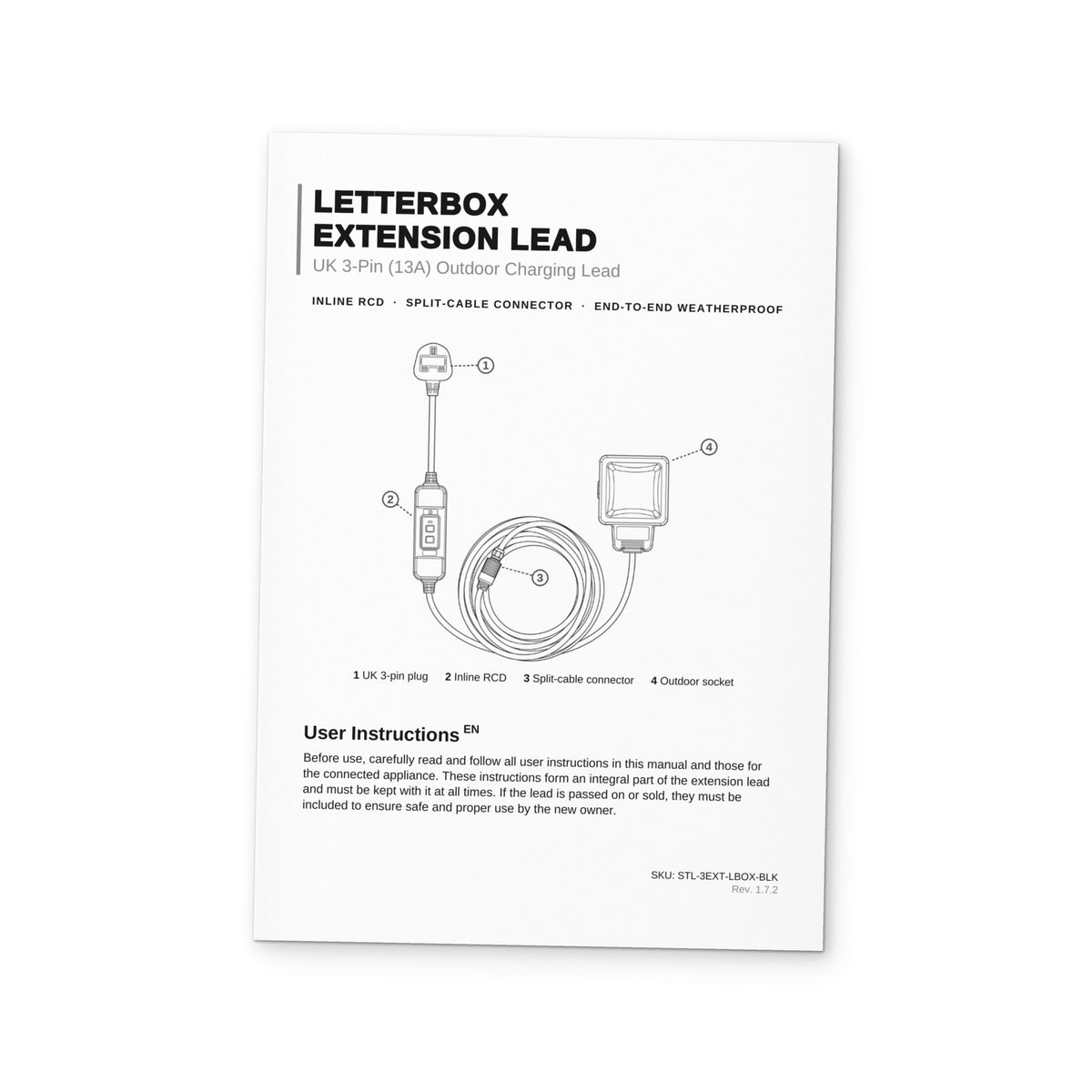
Hassle-free home charging for your hybrid or EV, directly through your door letterbox. Our EV-rated RCD-protected extension lead, fitted with a detachable IP-rated inline connector, safely extends the reach of your existing portable charger from any UK (3-Pin) indoor socket, keeping your car topped up without compromising your home's security.
Couldn't load pickup availability
Get in touch via WhatsApp.



Collapsible content
About this product
Specification
General Information
Rated Output
Operating Environment
Built-In Protection
Physical Properties
Safety & Care Advice
In the box
-

Letterbox Extension Lead
-

Drawstring Storage Bag
-

Microfibre Cleaning Cloth
-

User Guide


Delivery
Delivery
Returns
Frequently Asked Questions
FAQs
Why can’t I just use a "general use" domestic lead for EV charging?
A standard 3-pin plug or extension socket is too bulky to pass through a letterbox, which usually means leaving a door or window open while the car charges. Furthermore, a general-use extension lead is not rated for the sustained high-current draw of electric car charging, up to 13A continuously for several hours. Prolonged high current through undersized wiring generates excessive heat, creating a serious fire hazard.
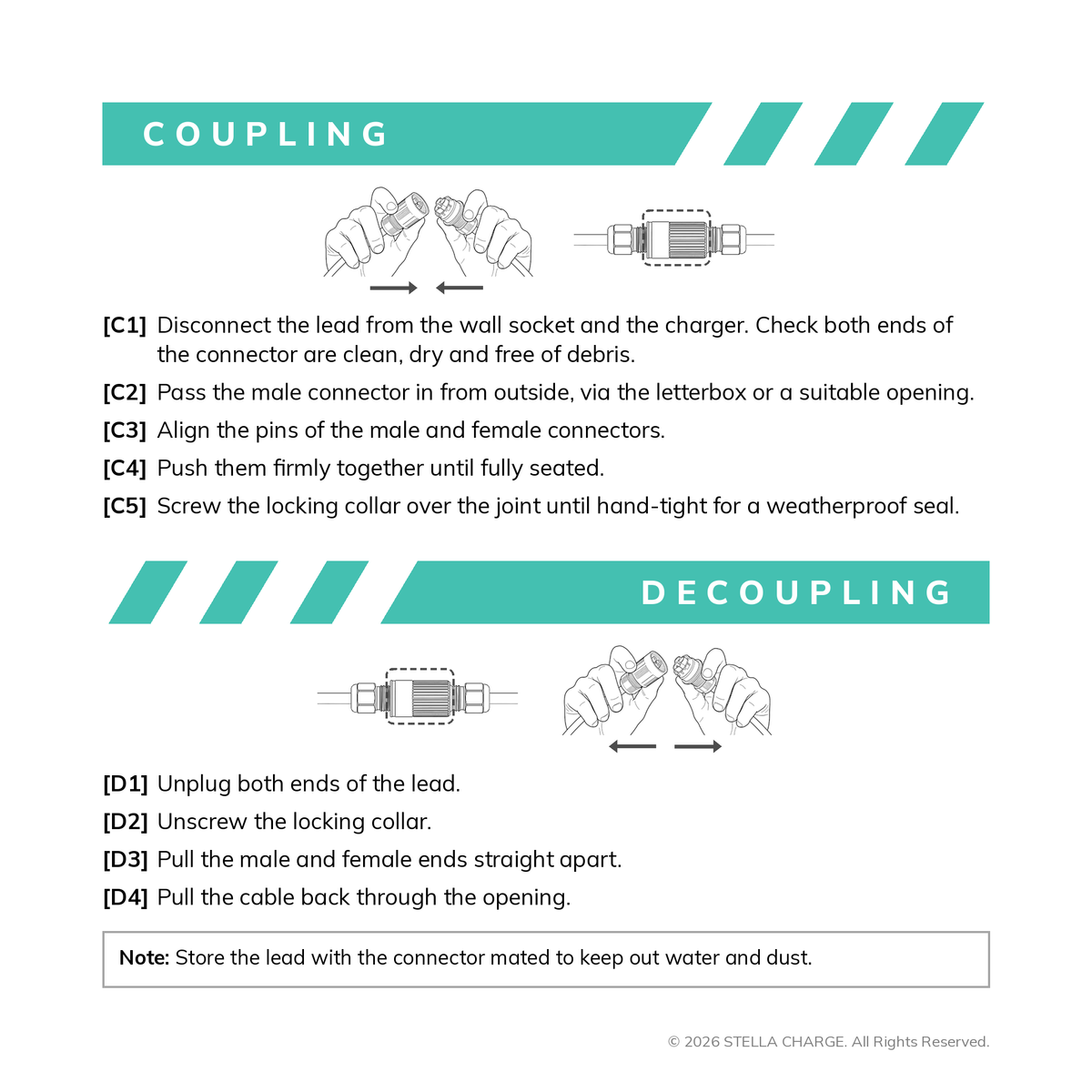
Our purpose-built extension lead uses heavy-duty 1.5mm² industrial-grade cable, an IP66-rated weatherproof enclosure, and an inline RCD with a 30mA trip threshold to automatically disconnect power in the event of a fault. Its inline 'letterbox' connector passes through gaps as narrow as 28mm, so the lead can run through your letterbox with the door closed and locked.
Should I buy this or your standard EV extension lead?
If there’s any chance you’ll need to run the lead through a narrow gap, choose this one. With the connector joined, it does the same job as our standard lead. The inline connector is rated IP68 for weather protection.
Can I also use it as a standard EV extension lead?
Yes. With the inline connector mated, it works just like our standard EV extension lead. The connector is rated IP68 for weather protection.
How does the RCD protection device work?
The inline RCD (Residual Current Device) is a life-saving safety feature built into our extension leads. It constantly monitors the electric current flowing through the cable. If it detects even a tiny imbalance which usually indicates a dangerous leak or a potential electric shock, it cuts the power instantly to keep you safe. It is an active (non-latching type) safety unit, meaning it trips to 'OFF' whenever the power supply is interrupted, so you must press the RESET button each time power is reconnected.
Full operating instructions are supplied with the extension lead.
Should I set the charge rate on my portable charger beyond 10A?
No. Even if your charger allows for higher settings, it’s best to stick to 10A or lower. Our extension lead is compatible with standard UK 13A sockets, and although these may supply 13A for short periods, drawing the full 13A for extended periods can cause the connected plug (and/or socket) to overheat. To ensure your equipment and wall sockets stay safe and damage-free, please keep the setting to 10A maximum.
Can I plug this EV extension lead into another extension lead?
No. For safety reasons, never daisy-chain EV extension leads. Our 10m to 20m options offer ample range for most charging setups.
Do I need to check the fuse clips inside the plug?
Due to the relatively high current used by EVs, it is good practice to check the internal connections are tight once a year (ensure the device is unplugged first). However, you should regularly check the outside of the plug for any signs of heat damage or scorching. If the plug ever feels uncomfortably hot (rather than just warm), stop using it and please inspect the internal clips immediately.